
Against affirmative action for populists
It’s not universities’ fault that today’s conservatism is anti-intellectual.
July saw a lot of action in Trump’s bullying lawfare against universities,1 which provoked a lot of discussion about ideological bias on campus. Here’s a sampling:
The administration demanded, under threat of severe financial penalty, that Harvard recruit more conservative faculty and students to foster “viewpoint diversity”—ironically, a form of affirmative action. The New York Times published an op-ed opposed to this.
Barry Lam made an important distinction between viewpoint diversity on campus and the Overton window of acceptable debate, with the latter probably being more important.
43 jackasses signed a truly unhinged Manhattan Statement on Higher Education, a document at least ten times as ideologically biased than the most left-leaning university in the country. David Bell diagnosed them University Derangement Syndrome.
Even right-winger Nathan Cofnas called out the absurdity of the right blaming institutional bias for its own “intellectuals” (ex: Jordan Peterson) behaving like turbo-morons.
All of this brought to mind a note I wrote to my old Professor last winter. I’ll elaborate below, but the TL;DR is that populism is innately anti-elite and anti-intellectual, so it is hard for elite universities to welcome populist sentiments without betraying their purpose in the first place.
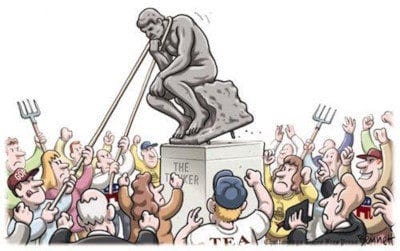
What’s the difference between me and you?
Steven Teles is a Senior Fellow at the Niskanen Center, which publishes the thoughtful Hypertext newsletter. After last November’s election, he wrote “The other diploma divide,” arguing that colleges had both moral and strategic reason to make campus more welcoming for conservatives.2 Here’s a key excerpt:
“Especially at elite universities, many conservatives experience campus life as profoundly alienating. They often report seeing a left culture suffusing everything in university life. That culture makes those who are on the left feel “at home,” but makes conservatives feel — often for the first time — as if they were less-than, barely-tolerated interlopers on someone else’s turf…
There are certainly conservatives who, as the sociologist Amy Binder and co-author have shown, have managed to make liberal universities their home. But they are disproportionately to be found among the NeverTrump and libertarian conservatives who are on the outs in the Republican Party, rather than the more populist Republicans who are likely to be its future."
This aligns strongly with my experience in Teles’ own class. Apart from Niskanen, Teles is a professor of political science at Johns Hopkins University, where he runs (ran?) the Aitchison Fellowship—essentially a program for Hopkins undergrads to intern in DC for a semester while taking policy classes together at night.
In 2014, I was among those students. There were about 15 of us, of which all but four leaned left. The professors (including economist Dean Baker) also leaned left. Of the non-leftists, I was the most outspoken.3 And the teaching method in every class involved substantial class debate. When conservatives say that liberal bias on campus is pervasive and intimidating, I can definitely relate! Time and again, it was me against the world.
I can’t tell you how much I loved it. And I can’t fathom feeling less at home in that environment than in today’s GOP.
I concede that I’m different from most people in relevant ways. Not everyone has my contrarian streak (and my contrarian streak was not independent of my being libertarian). It helped that I was on the debate team. It helped that I was damn smart! I relished the fights because I typically won, at least until the professors jumped in to bail out their younger selves and put me in my place.
But those eccentricities don’t refute my point, they just place me on the extreme end of the spectrum I’m describing. The main reason I was able to enjoy and hold my own in these conversations was not that I was smarter or cockier or better informed than my Hopkins peers, who were plenty nerdy in their own right. It was that I really, deeply cared about abstract ideas, even detached from their short-term political implications.
I would get lost in ideas for fun, on my own time. I had practice turning them over to examine from new angles, and that practice directly informed the beliefs I endorsed. I didn’t just know what I believed, but why I believed it, and why others believed what they did—in their own terms, not in my in-group's caricature. For people like me, being an intellectual minority was stimulating, not ostracizing, because it forced me to push myself and test my convictions. It gave me an outlet to let loose on bad arguments I’d spent years muttering about in my head.
The problem, to be blunt, is the kids who don’t do that. The ones who are either unable, or too proud, insecure, or indifferent to try. The ones who think we’re nerds for trying, because their conservatism is rooted more in their upbringing or identity than in lofty ideas to begin with. The ones who aren’t just Republicans, but MAGA Republicans.
The honest truth
Yes, campus culture alienates conservatives. But those it alienates most are defined by more than just conservative ideology. Libertarians do just fine in college because libertarianism is an actual ideology. It is rooted in clear principles, which its adherents take pains to apply consistently. Similarly, Never Trumpers became Never Trumpers for principled reasons.
When libertarians and Never Trumpers encounter left-leaning professors or classmates, they may feel outnumbered and defensive—but they have the mental tools to fight back, because they got where they are on the spectrum4 by engaging at the ideological level. As importantly, they have the tools to change and improve their beliefs, and those of their classmates, by addressing inconsistencies and coming out with something more nuanced. They feel like part of the club, even as a minority, because the club is defined by intellectualism.
MAGA hates universities because they can’t join that club. Because their beliefs are less ideas than inchoate moods.5 They typically lack the tools to engage at the ideological level—and deep down, they sense that. They see people who geek out to ideas as distrusted outsiders, and feel threatened by the entire project of reasoning towards truth in the first place.
Worse, they don’t want to learn when they’re wrong. As Stop the Steal made clear, their response to cognitive dissonance is to cover their eyes, plug their ears, and run for their echo chambers. And they will never consider universities sufficiently impartial until they legitimize that childish behavior as a coequal way of knowing.
They’ll never be satisfied until universities give up the pursuit of truth, pat them on the head, and pretend their beliefs are equally valid no matter how they acquired them. They're just not wired for what universities are about, but want their lazy and unrooted political sentiments to hold equal respect there anyway.
MAGA’s war on universities is partly an extension of its war against liberalism—another bullying, authoritarian power grab. But more than this, it is an extension of its war on intellectualism. Confas (who again, is conservative) writes:
“The leftist takeover of academia started 70 years ago. Conservatives had the power to resist, but they didn't because the average rightist doesn't care about ideas and idea-making institutions…This isn't a problem that can be fixed with better institutions. It's a human capital problem that can only be fixed by giving smart people on the left a reason to switch sides.”
I’m not opposed to the specific proposals Professor Teles endorsed in his piece. More conservative or veteran professors could be helpful for left leaning students too. But I’m very skeptical that this will make populist conservatives less hostile to universities. Universities exist to:
carefully reason towards empirical truth, through painstakingly formal institutions with methodical processes for knowledge creation; and
crown elites with credentials that set them apart in the workplace and grant them authority on factual questions.
Populism is innately hostile to both functions. It can’t be welcomed on universities without undercutting their purpose.
The core project of a university is not biased against conservative policy positions. It is not biased against Christians, or small government types, or advocates of a more restrained foreign policy. It is biased only against stupid or incurious people, and it’s not academia’s fault that Donald Trump made these a larger portion of the conservative whole.
After forcing UVA’s president to step down for being insufficiently vigorous in his dismantling of DEI, the Administration froze—and then eventually released—$7 billion in funds already obligated to schools across the country. The Supreme Court also upheld the dismantling of the Department of Education. I’m sure there were other things I missed.
This came shortly after David Brooks’ more famous piece in The Atlantic, How Ivy League Admissions Broke America, which I hope to engage with soon.
I say “non-leftists” because I was staunchly libertarian, but even then would have bristled to be called conservative.
(political, I mean, but sometimes also that other one!)
This is also why so few smart people take the “New Right” seriously. The whole collection of ideologies is transparently downstream of the tribal ooga booga that got Trump elected in the first place. He won in 2016 on culture war resentments, before the New Right existed, and then conservatives had to retroactively construct an ideology for him to pretend he stood for anything beyond narcissism and self-enrichment. (And yes: tribal ooga booga is all nationalism is).
There's surely some left-leaning people that don't care much about abstract ideas but they'd probably be comfortable at most universities. You wrote an entire article about how "late-stage capitalism" is complete nonsense in your opinion, but it seems very popular with college students. Why should MAGA be disqualified when it seems like plenty of people go to college without engaging with ideas? If colleges allow any leftie, but only right-wingers interested in abstract concepts, that does seem like a reasonable thing for right-wingers to attack.
Let's say MAGA is completely successful and takes over the universities. Every professor is Steven Sailor, Curtis Yavin is the most assigned author, Ben Shapiro is the dean etc. In that environment, there'd still be a small minority of left-leaning students that feel comfortable defending their ideas but many students would never have to question their MAGA thoughts. In that scenario, someone could write this with the parties reversed, right?
Besides that hypothetical sitation, I don't think populists would agree with how you define a university's function. Instead, like Ben Shapiro, they would argue that universities exist to function as a sort of "old boy's club", gatekeeping high-status and high-paying jobs and doling them out to ideologues and class allies. Or they could, like Brian Caplan, view most higher education as signaling. Both of these seem like coherent models to me, even if I don't agree with them. Both of those (very-educated) men signed the letter and I think that this unstated disagreement with you over the purpose of university is why they did so.
"is biased only against stupid or incurious people."
At this point, only the stupid and Incurious denied that current universities are run by the stupid and the incurious.