
DEI hyperbole is a building block for the New Right's alternate reality
Jacob Savage is reasonable and conservative Substack is not
Imagine I wrote a 9,000 word article with the following argument:
“I’m a white millennial man who was admitted to an Ivy League school in 2020, just when DEI was peaking. White men were proportionally represented in my cohort.
Also, here are statistics showing that from 2014-2024, three of the most conservative industries in the country1 maintained steady or elevated levels of white male millennial employees. I interviewed three unsuccessful minority applicants in those fields who felt they were denied positions unfairly during this time.
Thus, DEI had no excesses, and in fact did not go nearly far enough. Anyone complaining about it is in denial, probably because they hang out in conservative echo chambers where pushback is nonexistent. In fact, unless they wake up to this, Republicans might never win again.”
Would conservatives find this argument at all convincing?
Thankfully, that is not quite the mirror image of the viral article that Jacob Savage wrote for Compact Magazine. But it is the mirror image of what prominent conservative pundits want us to think that article proved.
For the past month, moderate conservatives have exaggerated this article’s findings for the psychic comfort of pretending that the out-of-touch radicals running our country are still on the left. Their more radical counterparts—including the administration and its allies—have used breathless hyperbole about DEI to justify literal apartheid and illegal authoritarian violence. This post will engage with Savage’s flawed but fair article, then explain why liberals rightfully distrust and don’t care about it right now.
I’ve written at length about the competing narratives over what DEI was and should be. Reasonable people can disagree on whether and to what extent minority applicants should have been favored over white male applicants from 2014-2024—and also to what extent they were favored, which is a separate question that surely varied by industry.
Savage’s piece provides a handful of statistics and about specific publications, universities, and professions that update me to think DEI was slightly more aggressive than I realized in those venues.2 It also provides other statistics that indicate nothing particularly amiss, and in fact are perfectly consistent with the liberal narrative on DEI. Even so, the article increased my confidence that during its brief and narrow peak, DEI was more aggressive than it should have been—an opinion I’ve already expressed.
And in place of a measured response that keeps this problem in perspective, The Ivy Exile opines to his 2,000 subscribers that: “The behavior of prestigious American institutions over at least the past twenty years can best be contextualized in terms of Rwanda: Hutus, Tutsis, and need for a truth and reconciliation commission.”
Yes, yes. A million people being butchered with machetes alongside their screaming children is the best contextual comparison for what American elites did to white men…
As compelling as that analogy is, here is some context that allows for an even better comparison.
The problem was smaller than Savage argued
54% of American millennials are white. Thus, 27% of millennials are white men. This is the base rate of proportional representation against which the statistics in Savage’s article must be compared.
In some relevant sectors, the base rate is even lower. For one thing, men and women self-select into different majors and professions. While men gravitate towards STEM or business, about two-thirds of journalism, communications, and English degrees in the United States are held by women.3 Savage at one point complains about the Los Angeles Times; but in Los Angeles, only 29% of the population is white, etc.
That context makes most of Savage’s statistics about journalism highly unconcerning:
The New York Times newsroom went from 57% male and 78% white in 2015 to 46% male and 66% white in 2024.
The Atlantic’s editorial staff shifted from 89% white and 53% male in 2013 to 66% white and 36% male by 2024.
BuzzFeed, a media operation that had been 52% male and 75% white in 2014, was just 36% male and 52% white by 2023.
At the California Times (parent company of The Los Angeles Times and The San Diego Union-Tribune), 2021 new hires were 39% male and 31% white.
Back in 2013, Vox Media was 82% male and 88% white. By 2022 the company was just 37% male and 59% white.
Okay…and??
It’s become so fashionable for conservatives to mock the left for allegedly not understanding how they think. Yet in this case, it is the right demonstrating no theory of mind for the progressive worldview.
To argue persuasively that there was unjust discrimination against white men, it is not enough to show a decline in white male representation. White male overrepresentation was the entire problem that DEI aimed to address. To show a decline towards more proportional representation fits exactly with the conception of justice trumpeted by DEI advocates, which was that playing field was formerly tilted towards white men, and we needed DEI to level it.
Nor is it enough to contrast the pool of applicants with the pool of admitted candidates, as Savage does several times. The left does not assume that the pool of applicants is proportionate to merit!4
Conservatives tend to conceptualize merit along an infinitely discrete spectrum, where you can rank every applicant from most to least qualified. But often, the left sees qualification more as a binary: you are either qualified or not qualified, depending on whether you surpass a minimum bar of capability needed to do the thing.
So if 100 people apply for 20 spots at a university, and 60 of those applicants would thrive academically, the left thinks all 60 are equally qualified, and that admitting any of those 60 is equally just. Conservatives don’t need to agree with that; I often disagree with it myself. But they do need a different argument if they want to persuade those who support DEI.
That’s not to say there were no illuminating statistics in Savage’s piece. The three industries into which Savage dove deep were journalism, academia, and Hollywood. All three are famously more left-leaning than the country at large. And as Sam Kahn noted, those of us who happened to be in those institutions during peak woke don’t need a big expose to convince us that the push went too far. Occasionally, Savage succeeds in showing that specific employers reduced white male hiring to implausibly low levels after 2020, which matches my vibes test completely.
The most damning statistics showed single-digit percentages of white male interns at places like The Washington Post and New York Times, and only 11.9% of low-level television writers. There were also ugly extremes in artistic and literary awards, like National Book Award finalists, MacArthur Fellowships, and major art galleries. Junior white male academics at elite universities seemed to be kind of screwed on career advancement. None of this was fair or necessary.
But professorships and book awards are elite people's problems, and these whole industries affect only a tiny sliver of the country. According to BLS data from 2023-2024:
Of the 60% of Americans who work, journalism (including “news analysts, reporters, and journalists”) employs 0.029%. Expanded to include “editors, producers, and anyone working any white-collar job for any newspaper, magazine, or text-based media publication,” it rises by a factor of 10—all the way to 0.27% of the working population.
The entire film and television industry, including production crews, studio staff, distribution of supplies, etc, is about or 0.5% of workers.
Academia—professors, lecturers, instructors, but excluding campus admin, student services, and student researchers—is about 0.9%.5
Add these together and you get about 1.7% of the workforce that was employed in the hyper-liberal sectors in which DEI hiring and promotion preferences briefly got out of hand. I’ll grant that those sectors have disproportionate visibility and cultural sway—that’s why the woke vibes were so strong for us hyper-online politics nerds, who swam in an algorithm elevating controversial content. But in terms of the material impact on white millennial men, what Savage documents was a niche institutional fad.
Late in his article, Savage makes a halfhearted effort to stretch this fad into a broader phenomenon, which allegedly cheated white men all across the economy. It falls flat. He notes that advertising, law, and medicine “are all less white and significantly less male than they were a decade ago”—but again, declines from how white and male they used to be are perfectly compatible with it being a more level playing field now. He notes that white men dropped from 31.2% of law school matriculants in 2016 to 25.7% in 2024—but again, white men are only 27% of millennials! 25.7 is pretty spot on.
“In 2014,” Savage continues, “white men were 31% of American medical students. By 2025, they were just 20.5%—a ten-percentage-point drop in barely over a decade.” But men are only 42% of all college students in general (and that’s not because they’re less likely to be accepted—the opposite is now true). With only 54% of millennial students being white, that leaves us with an expected figure of…22.7%. We’re two points off. A scandal, this is not.
Time and again, the statistics Savage cites in support of his argument that we’ve “gutted the American meritocracy” turn out to be perfectly consistent with the mainstream understanding of meritocracy, outside the ≈1% of workers who wanted to write for Hollywood or the Washington Post. As Matt Bruenig showed, a deeper dive into the economic fortunes of white male millennials at large does not show reduced opportunity or outcomes.6 The cultural excesses were real, but their material impact was minute.
Moderate conservatives’ fixation with DEI is more out of touch than today’s median Democrat
My last post made an important observation:
“Liberal elites face a genuine need to empathize with the feelings and concerns of everyday people. They should not confuse it with a need to cater to the emotional hangups of conservative elites.”
In DEI Denialism Could End The Democrats, David Dennison7 confuses his audience’s emotional hangups with the left’s political necessities. After recapping Savage’s article and the mockery it received on BlueSky, he affirms his audience’s feelings with a laughably thin argument:
“Resistance to discrimination is a powerful motivator of partisan preference. If they’re not careful, Democrats are going to find out what being on the wrong side of that feels like…
Voters, it turns out, don’t much like it when they think you’re coming after them on the basis of their identity. Conservatives have historically borne the brunt of this through their perceived animus against women and minorities, but what would happen if that dynamic changed?
…If [white men] were to become even more reliably Republican, the Democrats’ prospects would become insanely bleak. Take the 2024 election, which was close in terms of the popular vote:
White men were 34% of voters.
They broke for Trump over Harris, 59%.
If their support for Trump had mirrored the support African Americans offered to Kamala Harris (83%), Trump’s margin of victory would have rocketed from 1.5% to more than 17%. That’s a landslide.
Indeed, if white men were to start showing the Republicans the kind of partisan solidarity that black voters show Democrats, Democratic victory would become structurally impossible in American elections. Not unlikely, impossible….”
This is absurd for so many reasons. First, the high-water mark of DEI’s political salience has surely already passed. Democrats have dropped equity messaging it like it’s hot, and conservatives have to run as incumbents now. Second, that high-water mark probably came in 2020, when Democrats won the presidential election. Third: even in 2024, DEI was never a crucial issue for swing voters, who care much more about cost-of-living issues like inflation or healthcare.
Pockets of white grievance are real, but they’re strongest among people who already vote Republican! The 59% of white men who voted for Trump in 2024 likely includes nearly all of the people who are so mad about DEI that they let it impact their vote.
Also: the people most affected by DEI at its peak were educated, socially conscious elites—the very people who have the hardest time stomaching the foul populist potion of today’s Republican party.
There is simply no causal mechanism through which white male voters’ support for Republicans could jump to 83% (!) over this issue. Dennison does not seriously try to provide one. And after raising this utterly uninteresting question—why are Democrats in denial about this non-reality I just made up?—he slides right into providing his readers the one-size-fits-all answer they’re hoping to hear on every issue:
“…the [Democratic} movement appears not to be taking this threat seriously at all. It’s possible that they don’t really know how bad things have gotten, or how angry people are at them. Most leftists have a strong preference for social media safe spaces where pushback is virtually nonexistent. To the extent they use sites like Twitter, it’s for promotional pump and dumps. Post and runs. They’re hardly sticking around to read user comments.
Or could it be that they simply don’t care that much about the party actually winning?”
The irony is that conservatives’ equally “strong preference for social media safe spaces where pushback is virtually nonexistent” is the solitary reason why Dennison’s readers could find his argument at all persuasive. It is why this genre of article is so ubiquitous on conservative Substack. While 2018 Twitter chortled about how educated, empathetic, and anti-racist they were, today’s very-online conservatives have an endless circle-jerk about how much more in touch they are with American voters—which they are not, actually, on account of being so very-online.
What a moderate take actually looks like
Despite my disagreements with Savage, my subtitle said that he is reasonable. I award him that label for this self-aware sentence near the end of his piece, in which he simultaneously defends his point while keeping it in perspective:
“The fact that other groups, in other eras, have faced worse discrimination—that in the grand scheme of things, the disenfranchisement of white male millennials was relatively mild—is not itself an argument.”
I agree. Though it was relatively mild, there was indeed a brief window of time during which white men were unfairly and systematically disfavored in a select handful of high-status cultural fields. Over the course of about a decade, the intensity of this disadvantage varied from slight to substantial, with a peak lasting from about 2020 to 2023.
It is perfectly reasonable for the small number of white men passionate about those fields, who entered them at just the wrong time, to resent that unfairness. Just because it was a small problem at a societal scale does not mean its impact on their life was small. And because we can never know exactly who was denied positions, accolades, or status that they would have otherwise earned, the number of men justified in feeling resentful is slightly larger than the number that were actually disadvantaged. They shouldn’t have to wonder what might have been, and the left should not mock their valid feelings about it.
Here is another way to say the above that might help the right keep it in perspective:
There were 3-10 years during which 1.7% of one generation of white men faced occupational disadvantages approaching the severity that black men faced for over a century after slavery (without, of course, facing any of the violence or physical segregation).8
Coincidentally, 1.7% is exactly the same as the portion of millennials who identify as transgender—another group which faces ongoing stigma and mistreatment exceeding that of white men.
If a Democratic president used perceived discrimination against trans people in conservative states as a partial justification for armed military occupation of Houston, Tulsa, and Jacksonville, MAGA would be in armed revolt that makes the protests in Minneapolis look tame.
Which leads me to…
Far-right apoplexy over DEI is a building block for an alternate reality, in which white or Western civilization is under lethal threat
The last sentence of Dennison’s piece is unfortunately true: “our days as a robust, two-party state could come to a crashing close.” There are entirely plausible ways this could happen in the near future that Democrats have been warning about—for example, that Democrats and principled judges could be branded “terrorists” and persecuted by the state.
In the month since Savage’s article came out, these threats to liberal democracy have gotten noticeably worse. Increasingly, they are justified by allusion to a fabricated war on white people—a need to “defend the homeland” from purported “reverse colonization” and “race communism”—with the horrors of DEI presented as proof.9 The left’s reaction to Savage’s article cannot be understood in isolation from that much bigger and more present problem.

Here is a typical example. Last week, Elon Musk reposted the following image with the comment “Unfortunately, this is where America is headed.”
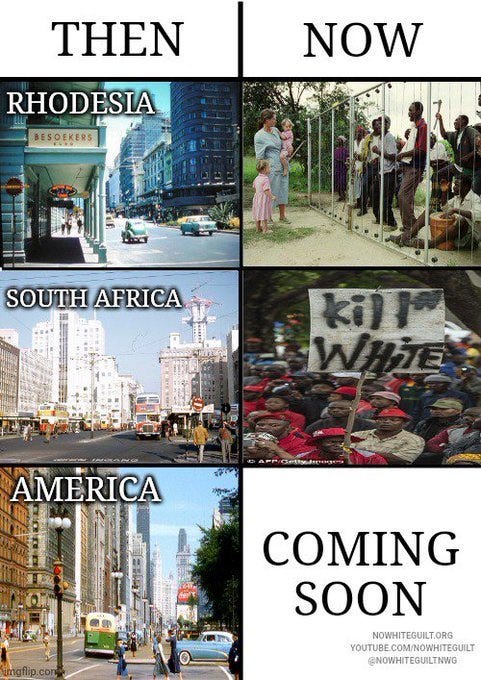
A white woman and her children are menaced by black men with an axe, holding signs that say “kill white.” The tweets Elon reposted called apartheid colonies “safe, clean…high civilization” while calling black natives to the “Dark Continent” the “primordial darkness of the Stone Age.” We’re called to resist the “race communism” and “anarchotyranny” of “Black rule and White erasure.”10 All of this is race war agitprop in direct defense of apartheid.11
Joe Lonsdale—billionaire founder of the defense contractor Palantir, who’s said his mission is to “save Western Civilization”—reposted all of this approvingly. And when he was called out for it, he dismissed as “nonsense” any implication of white supremacy:
“what I’m against here is anti-merit, and anti-white BS, and race communism - DEI as it was being enforced in the US was taking us down a dark path.”
See how this works? See how obvious the motte-and-bailey is, to warn about “kill white” and then fall back on DEI? And see how that race war rhetoric is then used as a blank check for authoritarianism to “take things back the right direction,” by the people imploring Trump to kill every communist in the Western Hemisphere?
The Department of Homeland Security is recruiting for ICE with the white nationalist song lyrics “We’ll have our home again.” The Department of Labor is tweeting homages to Nazi slogans.12 An Under Secretary of State calls migrants “barbarian rapist hordes.” Brazen propaganda videos defend the killing of a soccer mom for the crime of disobeying ICE, with the caption “Defend the Homeland. Protect the American way of life.” They play dumb to what Rhodesia was, to what ICE is doing, and to why people don’t like it.
And as soon as you press for details about what exactly places our homeland under such a mortal threat, you get hand-wavy reference to that brief period of time when white millennial men could not as easily be hired as junior screenwriters.
The people comparing DEI to Rwanda’s genocide of Tutsis are not getting innocuously carried away for want of a better analogy. They are toying with the most racially inflammatory rhetoric they can think of, from awareness that only a fantastic emergency could possibly justify the Administration’s behavior. No such emergency has ever existed, so they need to invent it.
They do this on every issue. It is plain as day to anyone paying attention.
Low-level drug dealers selling cocaine to Europe become “narco-terrorists” responsible for the U.S. fentanyl crisis. Charlie Kirk wasn’t killed by a lone wolf—he was killed by a sinister national network of “antifa terrorists.” Renee Good wasn’t peacefully defying ICE orders in civil protest—she was a violent “domestic terrorist.”
Anecdotes of an illegal immigrant committing a violent crime become an “invasion of military-age men” who are scapegoated for all the nation’s problems. The brief, cyclical, well-within-historical-norms spike in violent crime from 2020-2022 becomes an acute and ongoing crisis demanding military occupation of progressive cities.13
In every case it’s the same: take a real but small problem, multiply it by 100x, and froth at the mouth to justify authoritarian crackdowns. The actual, messy, nuanced facts never justify what new right extremists want to do, so they invariably have to be exaggerated and oversimplified. We could even make a new word for this:
Conserbole – the far-right tactic of wildly exaggerating claims with a kernel of truth to them, to construct the alternate reality they need to justify far-right behavior.
For so long as I remain uncertain about whether my country’s elections this fall will be corrupted by paramilitary voter intimidation or worse, it’s really fucking hard to give a shit about Jacob Savage’s screenwriting career. The fanfare surrounding his article plays dumb to the reality of what DEI has become in today’s politics: not an ongoing practice, so much as a rhetorical cudgel abused in service of far greater problems.
Ex: oil and gas, construction, commercial trucking, or industrial agriculture. Did DEI really run amok in those places?
(though still less prejudicial than society was against minority applicants for centuries, and less unjust than a dozen other problems that plagued our society during that decade).
I linked the journalism figure. Sources vary, but a quick scan of Google results suggests communications is about 60/40 women, English is about 30/70 women, and younger generations of women have only been gaining in their share of humanities degrees.
Progressives feel that the legacy of racism, sexism, etc. is a major obstacle to equal opportunity, and that subconscious prejudice and social stigmas color the applicant pool and prevent the best and brightest from rising to the top. Thus, progressives see DEI programs as leveling the playing field, either by directly combating those implicit biases or by correcting for their effects through affirmative action. Further, they see the ability to contribute new perspectives—to diversify an organization’s viewpoints—as a component of merit in itself, which is as valid to incorporate in an overall assessment of someone’s qualifications as any other performance indicator. It’s perfectly fine to disagree with these arguments, but to do so, you need different evidence than Savage presented.”
Including administrators and grad-student researchers would jump this to 2.37%, which (I’d agree with conservatives) is a sign of bloat in higher ed. But it doesn’t feel accurate to call student life administrators “academia.”
“What Savage and those sharing the piece appear to be responding to is primarily the mental impression that was caused by DEI messaging, which may have had an impact well beyond its actual material impact. The institutions Savage discusses in his piece employ approximately 0% of the US population, but their transformations plus DEI rhetoric plus an internet community aimed at negatively messaging about it all can generate the impression of something much bigger going on.” - Bruenig
Also with 2,000+ subscribers – I’m trying really hard not to pick on nobodies or argue with bots.
Conservatives: does this make it easier to understand why some black people “would not stop talking” about racism?
Another example I didn’t have space for in the comments: In defending the Venezuela strikes, Stephen Miller wrote an unhinged revisionist history of the post-WWII era, in which every clause of every sentence is false, and DEI is vaguely alluded to:
“Not long after World War II the West dissolved its empires and colonies and began sending colossal sums of taxpayer-funded aid to these former territories (despite have already made them far wealthier and more successful). The West opened its borders, a kind of reverse colonization, providing welfare and thus remittances, while extending to these newcomers and their families not only the full franchise but preferential legal and financial treatment over the native citizenry. The neoliberal experiment, at its core, has been a long self-punishment of the places and peoples that built the modern world.”
He later wrote on Twitter “if Democrats won they would have made every city into Mogadishu or Kabul or Port-au-Prince,” echoing the racist implications of Musk’s post.
Anarchy and tyranny represent opposite ends of how powerful the government is, but anyway…
For the unaware, Rhodesia was an illegal British colony in modern-day Zimbabwe, which from 1965 to 1979 was the last gasp of British domination of the country.
“We’ll have our home again” is the title of a neo-Nazi song, followed by “Join.ICE.gov”. “One Homeland. One People. One Heritage.” is an intentional homage to the Nazi German slogan “Ein Volk, ein Reich, ein Führer” (One People, One Realm, One Leader).”
Matt Yglesias put it well:
“There’s no emergency requiring the dispatch of National Guard personnel into cities where they’re not wanted, and there’s no ongoing “invasion” of the country by asylum seekers. What we have is an administration that refuses to tout good news, because it loves the idea of a country immersed in crisis as a pretext to seize even more power.”
Conservatives figured out that being a marginalised group actually sucks a lot but the left forgot that white people are the majority of the country and racial identity politics works even better if you are in the majority. Conservatives should apply the lesson of marginalised groups, and the left should understand that the stigmatisation of racial identity politics is actually good for racial minorities.
Your astonishing unwillingness to engage with actually existing pipelines is kind of hilarious. “Savage at one point complains about the Los Angeles Times; but in Los Angeles, only 29% of the population is white, etc.”
This is next level LOL — what are the demographics of the Southland’s population who read the LA Times? What are the demographics of those who are college-educated and want to be journalists?